Laden...

Laden...
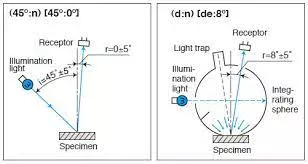
In the practice of industrial color control, confusion about color measurements regularly arises. A frequently heard question is: "Why don't my color measurements match?" The cause often lies in misinterpreting two concepts: measurement geometry and Standard Observer. These each have their own meaning but are often confused.
Measurement geometry describes how an instrument (colorimeter or spectrophotometer) illuminates the sample and how the detector captures the reflected light. The most commonly used geometries are 45°/0° and d/8°.
Here, light falls on the sample at an angle of 45°. The detector measures the reflected light at 0° (perpendicular to the surface).
This geometry approximates visual assessment under standard lighting and is widely used in paint, coatings, plastics, and printing.
The designation d stands for diffuse illumination: the sample is illuminated from all directions by light that is diffusely distributed in an integrating sphere. Measurement takes place at 8° from the normal.
This method is used when uniform, non-oriented illumination is desired, for example with materials with texture or gloss variations.
The terms 2° and 10° refer not to the instrument or measurement angle. They relate exclusively to the visual field of the human observer, as established by the CIE in the so-called Standard Observer.
In industrial color measurement, the 10° observer is increasingly recommended because it is more realistic for product formats. However, 2° data is still used in many standards.
The confusion arises because both measurement geometry (e.g., 45°/0°) and Standard Observer (2°/10°) are expressed in degrees. Yet they describe completely different things:
| Concept | Concerns | Purpose |
|---|---|---|
| Measurement Geometry (45°/0°, d/8°) | Position of light source and detector | How the instrument measures |
| Standard Observer (2° / 10°) | Human visual field | How color values are mathematically calculated |
Correctly specifying which combinations were used is crucial for being able to reproduce and compare measurements within the chain.
When different suppliers collaborate in a chain, color measurements must be completely transparent. This means:
Only then can a color value be accurately reproduced by another party.
In the courses of the Dutch Color School, you will learn:
👉 View the Applied Color Technology course at: https://kleurenschool.nl
Questions about color measurement, measurement geometry, or instrumentation? Contact the specialists at the Netherlands Color Institute: https://snki.nl/en/contact
A color measurement rarely goes wrong because of the instrument, but because of the conditions around it. The ten most common mistakes in measuring and assessing color — and how to avoid them.
A spectrophotometer approves the color, but your eye sees a difference. Why that happens — metamerism, spot measurement, Delta E — and which decision rule to use.
You agree on color with a supplier not with words but with L*a*b* and ΔE. This is how you record color, tolerance and measurement conditions unambiguously — and avoid surprises at delivery.