Laden...

Laden...
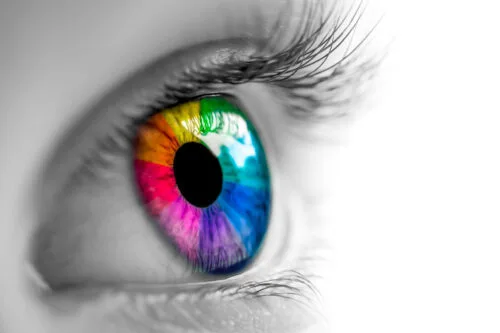
The human visual system is impressive: we can distinguish millions of color nuances, recognize subtle variations, and grasp patterns at a glance. Yet it is not reliable enough to make color-critical assessments without tools. Visual color perception is influenced by countless factors — from light and environment to physiology and psychology.
Below we outline the most important limitations that every color professional should know.
Color exists by the grace of light. An object can appear completely different under daylight (D65) than under incandescent light (A) or LED.
A white surface can:
Assessment without standardized light therefore almost always leads to variation and discussion.
Our eyes continuously adapt to their environment. After some time in warm light, neutral colors appear cooler as soon as you walk to a room with daylight.
This adaptation effect works unconsciously and influences every evaluation, even for experienced assessors.
Even within a professional team, people never assess exactly the same.
The color of the environment influences the perception of the color being assessed. A color can:
Therefore, a neutral environment (mid-gray) is essential for visual assessment.
Two colors can appear identical under one light source but different under another. Metamerism is one of the biggest pitfalls in production and quality processes.
Without multi-illuminant assessment (e.g., D65, A, TL84), a reliable judgment is impossible.
Words like reddish, too warm, slightly lighter, or more hue are inherently interpretive. Without technical color language (L*, a*, b*, C*, h°, hue), misunderstandings and errors in production arise.
Yes — but only within the limits of their capability. For color-critical applications, visual assessment alone is not sufficient.
Professionals therefore combine:
Visual assessment remains an essential skill, but only in combination with objective measurements can color be reliably qualified.
In the Applied Color Technology course, you will learn:
👉 More information: kleurenschool.nl
Questions about visual color assessment or instrumental measurements? Contact us at info@kleurinstituut.nl or call +31 (0)70 364 98 02.
Even the best color assessor has a biological limit. Why two or more assessors judge more reliably — and how the 2+1 method makes that practical and affordable.
A color measurement rarely goes wrong because of the instrument, but because of the conditions around it. The ten most common mistakes in measuring and assessing color — and how to avoid them.
In a professional color process, 'red' is at least seven different things. Why that distinction is the foundation beneath reliable color management.