Laden...

Laden...
Luminance Reflectance Value (LRV), lightness L*, and spectral values each describe in a different way how a color reflects light and how it is visually perceived. This article systematically explains the technical differences using RAL 3000 as an example.
LRV describes what percentage of visible light is reflected by a surface.
A low LRV means little reflected light and therefore an optically dark color.
Example — RAL 3000 RAL 3000 has an LRV of approximately 15%. Only a small portion of the incident light is reflected; the rest is absorbed. The color therefore appears visually dark and reflects little light in applications.
Lightness L* is a perceptual measure from the CIELAB space, ranging from 0 (black) to 100 (white). L* describes how bright a color is experienced by an average observer, independent of the technical reflectance value.
Example — RAL 3000 A lightness L* ≈ 45 means that the color is perceived as moderately bright, despite the low LRV. This illustrates that LRV and L* can differ significantly in meaning: L* is perception-oriented, LRV is physical/energetic.
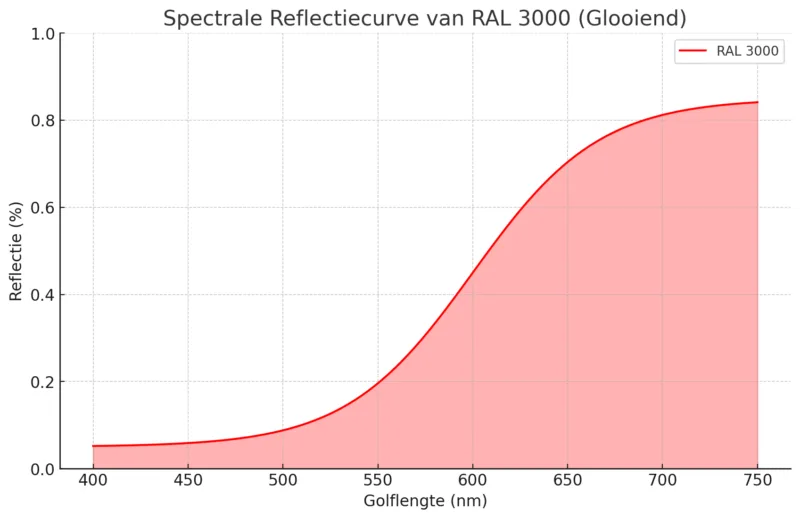
Spectral values describe the reflectance per wavelength between 400–750 nm. Unlike LRV (one number) or L* (perceptual scale), spectral values provide a complete reflectance curve.
Hypothetical Profile — RAL 3000
The color appears red because primarily red light is reflected.
Spectral data form the basis for:
| Property | LRV | Lightness L* | Spectral Values |
|---|---|---|---|
| Type of information | Energy reflection (%) | Perceptual brightness | Reflectance per wavelength |
| Number of values | 1 | 1 | 31–41 values (depending on measurement interval) |
| Application | visibility, regulations, safety | design, perception, UI/UX, architecture | formulation, metamerism, production control |
| Example RAL 3000 | ~15% | ~45 | high reflectance in red region |
Spectral values are necessary for detecting metamerism and guaranteeing matches under multiple light sources.
LRV is used in regulations for visibility, contrast measurements, and design of public spaces.
L* helps in estimating visual brightness and creating functional contrasts in interior, product, and graphic design.
Spectral values are essential for formulations, quality control, and the selection of pigments or coatings.
Architects, designers, and construction consultants use LRV to:
A correct interpretation of LRV is necessary for applications, specifications, and product selection.
LRV, lightness L*, and spectral values each describe a different dimension of color:
A good understanding of these three parameters makes it possible to technically correctly assess, formulate, and apply colors in professional design and production processes.
👉 Want to learn more about color measurement and technical color parameters? View the courses at kleurenschool.nl
Questions about LRV, L*, or spectral measurements? Contact us at info@kleurinstituut.nl or call +31 (0)70 364 98 02.
A color measurement rarely goes wrong because of the instrument, but because of the conditions around it. The ten most common mistakes in measuring and assessing color — and how to avoid them.
The aging eye sees a different room: less light, less contrast, shifted colors. Why color in elderly and dementia care demands stricter contrast requirements and warm tones — and why red is so important.
You agree on color with a supplier not with words but with L*a*b* and ΔE. This is how you record color, tolerance and measurement conditions unambiguously — and avoid surprises at delivery.