Laden...

Laden...
Color difference formulas describe how large the difference is between two colors based on measured values. These formulas are applied in quality control, color matching, and production processes where color consistency is required. In this article, the main color difference formulas within the CIELAB domain are systematically explained.
Color difference formulas provide an objective measure to quantify visibly perceptible differences between two colors. They are used in:
Correct application supports acceptance criteria, product standardization, and communication between producers and suppliers.
The CIE76 formula is the oldest ΔE method and defines the color difference as the Euclidean distance between two points in the CIELAB space.
ΔEab = √(ΔL² + Δa² + Δb²)
Characteristics:
Despite limitations, CIE76 is still widely used due to its simplicity.
The CMC formula introduces variable tolerances for lightness, chroma, and hue.
The flexibility makes CMC useful for process-dependent tolerances.
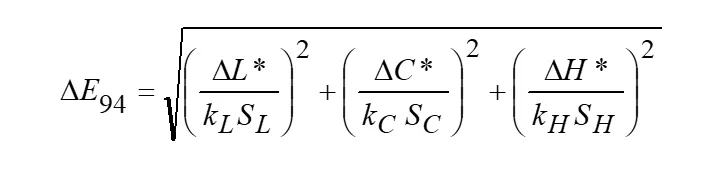
CIE94 builds on CMC, but with different weighting functions and additional parameters.
CIE94 has long been the industrial standard and is still used in many quality control systems.
The most advanced and best approximation of human perception.
Although ΔE00 is perceptually the most uniform, the mathematical structure is considerably more complex.
The right color difference formula depends on:
Regardless of the formula, tolerances should be derived from historically accepted product variation and visual evaluations. The MacAdam ellipses remind us that no ΔE formula is perfectly uniform.
When implementing color difference formulas, it is important to:
👉 Want to learn more about color difference formulas and tolerance management? View the courses at kleurenschool.nl
Questions about ΔE formulas or CIELAB analyses? Contact us at info@kleurinstituut.nl or call +31 (0)70 364 98 02.
A color measurement rarely goes wrong because of the instrument, but because of the conditions around it. The ten most common mistakes in measuring and assessing color — and how to avoid them.
A spectrophotometer approves the color, but your eye sees a difference. Why that happens — metamerism, spot measurement, Delta E — and which decision rule to use.
You agree on color with a supplier not with words but with L*a*b* and ΔE. This is how you record color, tolerance and measurement conditions unambiguously — and avoid surprises at delivery.