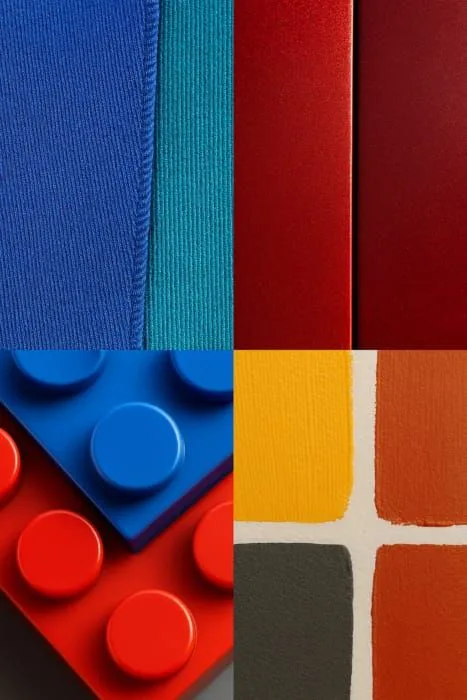
Color quality in materials is determined by the specific light interaction of each material type. Because materials reflect, absorb, or scatter differently, color assessment per substrate requires a material-specific approach. This article provides a structured overview of measurement methods, tolerances, and practical solutions for color quality per material.
What Determines Color Quality in Materials?
Color in physical materials arises from the interaction between light and surface structure. Several factors play a role:
- reflection behavior
- gloss level
- absorption and scattering effects
- internal transmission (for transparent or semi-transparent materials)
- surface structure and homogeneity
Each material type introduces unique challenges for both visual assessment and instrumental measurement.
Material-Specific Properties
Plastics
- Transparency varies from completely clear to completely diffuse.
- Thermoplastic behavior affects pigment dispersion and final color.
- Process parameters such as temperature, pressure, and cooling time cause color deviations (10–15 °C difference can already be visible).
- Decisive for translucent plastics: internal scattering and optical depth.
Metal
- Reflection depends on surface finish, oxidation, and coating thickness.
- Multi-angle effects with metallic coatings: color changes with viewing angle.
- High sensitivity to metamerism under different light sources.
Textile
- Fiber type determines absorption: cotton ≠ polyester ≠ wool.
- Weave structure affects shadow formation and local color variation.
- Dichroism: different color impression when viewing direction changes.
- Variation within the same sample → multiple measurements necessary.
Color Consistency Between Different Materials
Achieving visual consistency across multiple substrates (e.g., plastic, metal, and textile within one product line) is one of the most common color technical problems.
Factors causing inconsistency:
- differences in gloss level
- surface structure (smooth, rough, fibrous)
- physical-optical properties per material
- variations in color formulations per substrate
ISO 3664:2009 is essential for uniform visual assessment under standardized lighting conditions.
Measurement Challenges per Material
| Material | Preferred Method |
|---|
| Glossy metals | Multi-angle spectrophotometry (ASTM E2194) |
| Matte powder coatings | D/8 geometry, SCI/SCE depending on specification |
| Textile | Multiple measurements, rotated sample (AATCC EP9) |
| Transparent plastics | Transmission measurement + haze (ASTM D1003) |
Surfaces with variable structure (such as textile, foam, perforated materials) always require multiple measurement positions for representativeness.
Material-Specific Solution Approaches
Plastics
- Use light-scattering additives for homogeneity.
- Optimize process parameters (temperature, pressure, cooling).
- Measure only on representative test pieces with the same thickness as the final product.
Metals
- Apply anodization, primer coats, or coatings for color stability.
- Document angle-dependent variation with metallic coatings.
- Use multi-angle measurement for effect pigments.
Textile
- Adjust formulations per fiber type.
- Use fixation and wash tests for stability.
- Combine instrumental measurement with controlled visual evaluation.
Color Tolerances per Material
Tolerances are not universally applicable; perceptual sensitivity differs per material.
- Automotive: very strict ΔE tolerances, especially for exterior panels.
- Plastics: tolerance depends on gloss and structure; glossy surfaces require lower ΔE.
- Textile: preference for CMC(2:1) due to better correlation with visual assessment.
Relevant standards:
- DIN 6175 for automotive paints
- CMC(2:1) for textile
- CIEDE2000 for critical color assessments
Structure for Quality Assurance
1. Material-Specific Reference Collection
- Maintain physical reference samples under controlled conditions.
- Document validity period, aging, and revision moments.
2. Customized Measurement Protocols
Elements that must be recorded:
- instrument type and geometry
- measurement settings (SCI/SCE, d/8, multi-angle)
- position and number of measurements
- condition of the sample (e.g., drying time)
3. Standardized Visual Assessment
- Use light booths according to ISO 3664.
- Avoid assessments under uneven office or daylight conditions.
4. Cross-Functional Alignment
- Design, purchasing, production, and QC must use the same color definitions, tolerance limits, and assessment protocols.
- Material knowledge must be centrally recorded to prevent interpretation differences.
Conclusion
Color quality per material requires a systematic, material-specific approach. Due to differences in optical properties, measurement behavior, and tolerance perception, each material must receive its own measurement method, formulation strategy, and quality protocol. With clear standards and streamlined work processes, color consistency can be significantly improved and errors minimized.
👉 Want to learn more about material-specific color quality? View the courses at kleurenschool.nl
Questions about color quality or measurement protocols?
Contact us at info@kleurinstituut.nl or call +31 (0)70 364 98 02.
References
- Green, P. (2010). Color Management: Understanding and Using ICC Profiles. Wiley.
- Nassau, K. (2001). The Physics and Chemistry of Color. Wiley.
- Chauhan, A., & Chauhan, P. (2014). Powder modification for plastic industry by light scattering.
- ASTM E2194-14. Multiangle Color Measurement of Metal Flake Pigmented Materials.
- Xin, J.H. (2006). Total Colour Management in Textiles. Woodhead Publishing.
- McDonald, R. (1997). Colour Physics for Industry. SDC.
- ISO 3664:2009. Viewing conditions for visual color evaluation.
- Berns, R.S. (2000). Billmeyer and Saltzman's Principles of Color Technology. Wiley.
- ASTM D1003-13. Haze & Luminous Transmittance of Transparent Plastics.
- AATCC EP9. Visual Assessment of Color Difference in Textiles.
- Zwinkels, J. (2008). Light, Color, and Appearance Measurements of Materials.
- Pfaff, G. (2008). Special Effect Pigments. Vincentz Network.
- DIN 6175-2:2001-03. Tolerances for automotive metallic paintwork.