Laden...

Laden...
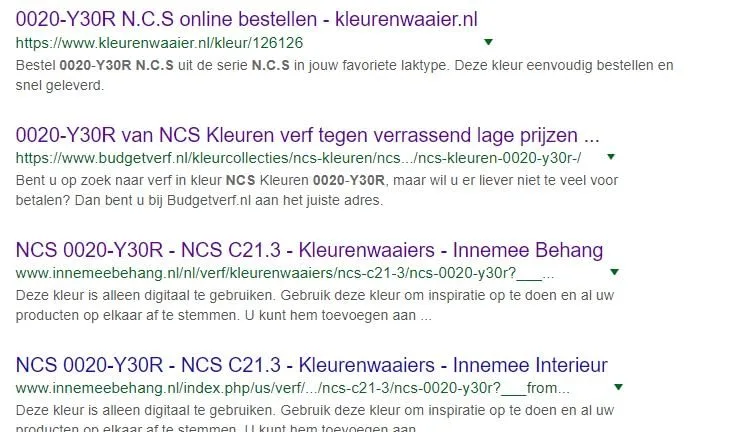
You encounter it frequently on the internet. Websites offering NCS colors as RGB representation, so you can get an idea of the color. In the eagerness of paint suppliers and other color providers, things are sometimes overlooked. You often see NCS colors that start with 00 — followed by the rest of the code.
Those colors don't exist. At least, not anymore.
The NCS system was developed from the 1930s to 1980. In 1979, the first NCS atlas was published with a selection of 1,412 colors. In 1984, 118 colors were added. This was the first edition.
The color notation of these colors starts without S. The very light colors (pastel shades) start with 00 — indicating that the color contains no black. This is followed by the saturation component and the hue.
First edition example: 0020-Y30R
In 1995, the NCS system was revised to comply with EU environmental requirements regarding lead-containing pigments. Many colors changed because other pigments had to be used.
At the launch of the second edition, the first edition colors were completely discontinued. Colors of the second edition always start with S — from standard NCS color.
Second edition example: S 1020-Y30R
During the revision, the principle was adopted that a color always has a black component, a white component and chromaticness. A notation starting with 00 indicates there is no black in the color. In the second edition, that starting point was abandoned: every NCS color has a black component.
That's why a color like 0020-Y30R or 0050-B30G doesn't exist in the current NCS system.
The unfortunate thing is that many paint machines still have all first edition colors in the system. This means you can create a color that officially no longer exists — and that differs from the current standard.
Note: 1010-Y20R is a different color than S 1010-Y20R.
The S makes the difference. Always check if the color code starts with S. Without S you're working with a discontinued notation.
| First edition (1979) | Second edition (1995–present) | |
|---|---|---|
| Prefix | None | S |
| 00-codes | Yes (no black) | Don't exist |
| Status | Discontinued | Current |
| Example | 0020-Y30R | S 1020-Y30R |
| Available | No longer supported | NCS Index 2050 |
Want to know why colors like 5050-B90G and 2090-Y90R don't exist? That has to do with the geometry of the NCS color space — not every combination of blackness and chromaticness is possible for every hue.
Related products:
Related services:
In a professional color process, 'red' is at least seven different things. Why that distinction is the foundation beneath reliable color management.
The municipality of Den Helder demands that a bright green house be repainted: the color is allegedly not a pastel color. But what are pastel colors exactly? An analysis using the NCS system.
RAL is more than 216 colors. Discover the three RAL collections, from Classic to Design System plus with 1,825 CIELAB-based colors. Everything about coding, differences, and applications.