
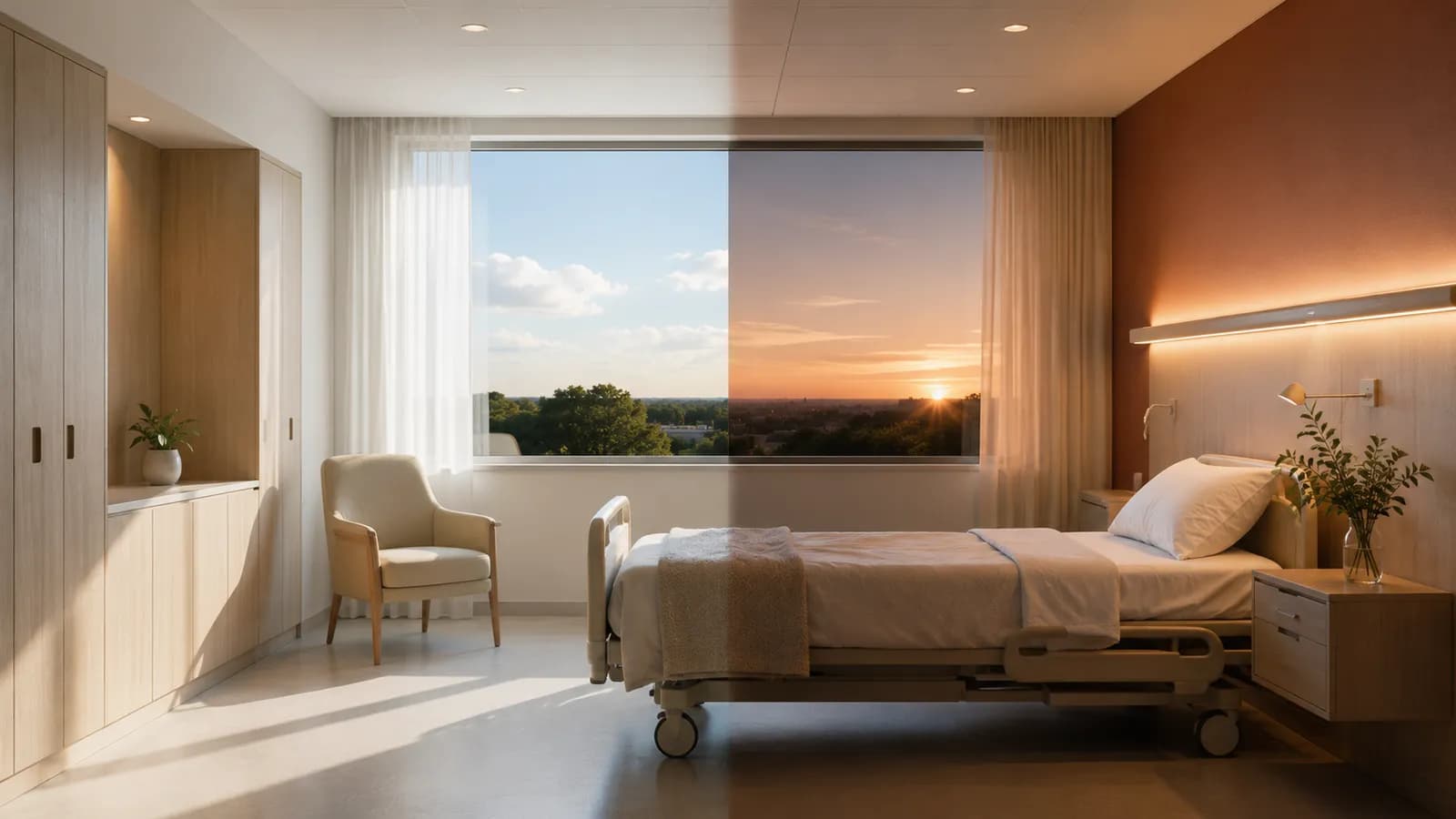
A hospital knows no night — and that harms recovery. Why the day-night rhythm, dynamic lighting and wall color together form one system in the healthcare environment.
The human body runs on an internal clock of roughly twenty-four hours. That clock regulates when we sleep and wake, when we are alert or tired, and how well our recovery and immune defenses function. The most important signal that sets the clock is light — and not just any light, but the right amount and color at the right moment of the day. Special cells in the retina measure primarily the blue light and pass this on to the biological clock, which on that basis suppresses or triggers the production of the sleep hormone melatonin.
1. The Building That Erases the Rhythm
Hospitals have traditionally been built to run around the clock. Corridors are brightly lit at night, equipment emits a blue-white glow, and during the day, daylight in many rooms is limited or curtained off. The result is an environment in which day and night hardly differ from each other in terms of light.
That is not a matter of comfort. A disturbed day-night rhythm is a recognized risk factor for delirium — an acute confusion that occurs mainly in elderly and seriously ill patients, prolongs the stay and invites complications. Healing and immune defense also suffer from a night that is constantly interrupted by light and noise. And it does not only affect patients: staff working long shifts without daylight report more fatigue and poorer concentration.
2. What Dynamic Lighting Does
The solution that follows is light that moves with the day: bright and cool in the morning to wake people up, decreasing and warmer over the course of the day, dimmed and warm in the evening to prepare for the night. In research on a ward with dynamic lighting, patients slept on average almost half an hour longer per night and woke up less often at night. Over a ten-day stay that adds up — a relevant difference for a recovering body. At the same time, light is not the only lever: as an isolated measure it does not prevent delirium. It only works as part of a broader approach of light, noise and rest together.
3. Color and Light Cannot Be Separated
For anyone who works with color, this is the most important insight: lighting and wall color act upon each other. A warm wall tone — ochre, terracotta, off-white in the warm direction — reinforces warm evening light and deepens the evening atmosphere. But a cool, hard wall color under that same warm evening light feels restless, because the two temperature signals contradict each other. Anyone who has a dynamic lighting system installed but keeps the walls cool does not get the full effect out of it. A warm, light neutral base palette, on the other hand, supports both the activating effect of morning light and the calming effect of evening light.
This is where the distinguishing point lies for anyone advising on color. A lighting supplier delivers a dynamic fixture; what it does not deliver is the wall on which that light falls. And it is precisely that wall that determines whether the dynamics work. Choose the wall tone too cool or too saturated and the color fights the warm evening light instead of carrying it, and part of the effect the lighting system was bought for evaporates. Choose it warm and muted and light and color reinforce each other throughout the day. The lighting and the color are therefore not two separate items in a specification but one design decision — and it is precisely at that intersection that color knowledge makes the difference technology alone cannot make.
This also means the wall color must never be assessed under a single lighting condition. A sample that looks perfect in the showroom's daylight can tip over under the warm night lighting of the ward. Anyone who chooses color for a healthcare space therefore tests it under all lighting conditions under which the space is actually used — and that is an assessment discipline, not a matter of taste.
4. Why Blue Light in Particular Drives the Rhythm
That blue light of all things drives the clock is no coincidence. Besides the cells we see with, the retina contains a separate group of light-sensitive cells that do not produce the image, but keep track of time. These cells are most sensitive to the blue wavelengths, and they report to the biological clock in the brain how much blue light is coming in at any given moment. Lots of blue means to the body: it is daytime, be alert. Little blue means: night is coming, produce melatonin and prepare for sleep.
Herein lies exactly the reason why the same color of light is useful at one moment and harmful at another. During the day, and certainly in the morning, blue-rich light is functional: it suppresses melatonin production, keeps the body awake and sets the clock. In the evening and at night, that same signal backfires: the body receives the message "day" at a moment when it should be preparing for the night. So it is never about blue light as such, but about blue light at the wrong hour — and a healthcare environment lit blue-white at night gives that wrong signal precisely when recovery calls for rest. Screens, blue night lighting and corridors that are not dimmed at night thus deliver a constant low dose of blue that suppresses melatonin production and undermines sleep — at the very moment the body needs that production.
5. Daylight Is Irreplaceable
However well an artificial system is tuned, it does not replace daylight. Daylight changes naturally in intensity, color and direction over the day, it reaches levels artificial light indoors rarely achieves, and it contains the full spectrum the biological clock needs. That is why living spaces and patient rooms should receive as much daylight as possible, preferably with a view of greenery — connecting the day-night rhythm to the broader finding that views and daylight support recovery.
Where daylight is lacking — in interior rooms, connecting corridors, spaces deep inside the building — artificial lighting must imitate it as closely as possible. A handy principle helps: during the day and in the morning bright and cool to activate, over the course of the afternoon and evening decreasing in intensity and warmer in color, and at night warm, soft and as dimmed as safe working allows, with a minimal blue component. A dynamic system without daylight is better than a static system, but still falls short of a design that structurally brings daylight in. The order is therefore clear: daylight first, then artificial light as a supplement — and the wall color is tuned to both.
6. What This Gives You
Design color and light as one system, and assess it across the entire daily cycle — morning, afternoon, evening and night. A palette that has only been viewed in daylight has not been fully tested. Choose a warm, light neutral base palette that holds up under cool morning light and warm evening light. And above all: bring in daylight wherever you can. However good an artificial system is, it does not contain the spectrum the biological clock needs as completely as the sun. Daylight is the first choice; artificial light is the necessary supplement.
How to align light and color in a healthcare project is covered in the workshop Applied Color Science in Healthcare.
Source: Kotterink, M. (2026). Kleur in de Gezondheidszorg. Uitgeverij SNKI. Including the work on light-sensitive retinal cells and the circadian clock (Berson et al. 2002; Brainard et al. 2001) and research into dynamic lighting in healthcare (Giménez et al. 2016; Simons et al. 2016).
Frequently asked questions
Why should color and light in healthcare be designed together?
Because the body has a biological clock of ~24 hours that is set by light (especially blue) and controls melatonin production. Hospitals often erase that day-night rhythm (bright/blue light at night, little daylight during the day), which is a risk factor for delirium and slower recovery. Dynamic lighting (cool/bright in the morning, warm/dimmed in the evening) improves sleep, but only works together with the wall color: a warm wall tone reinforces warm evening light, a cool wall works against it. Therefore design color and light as one system, test across the entire daily cycle and bring in daylight wherever possible.
Related articles
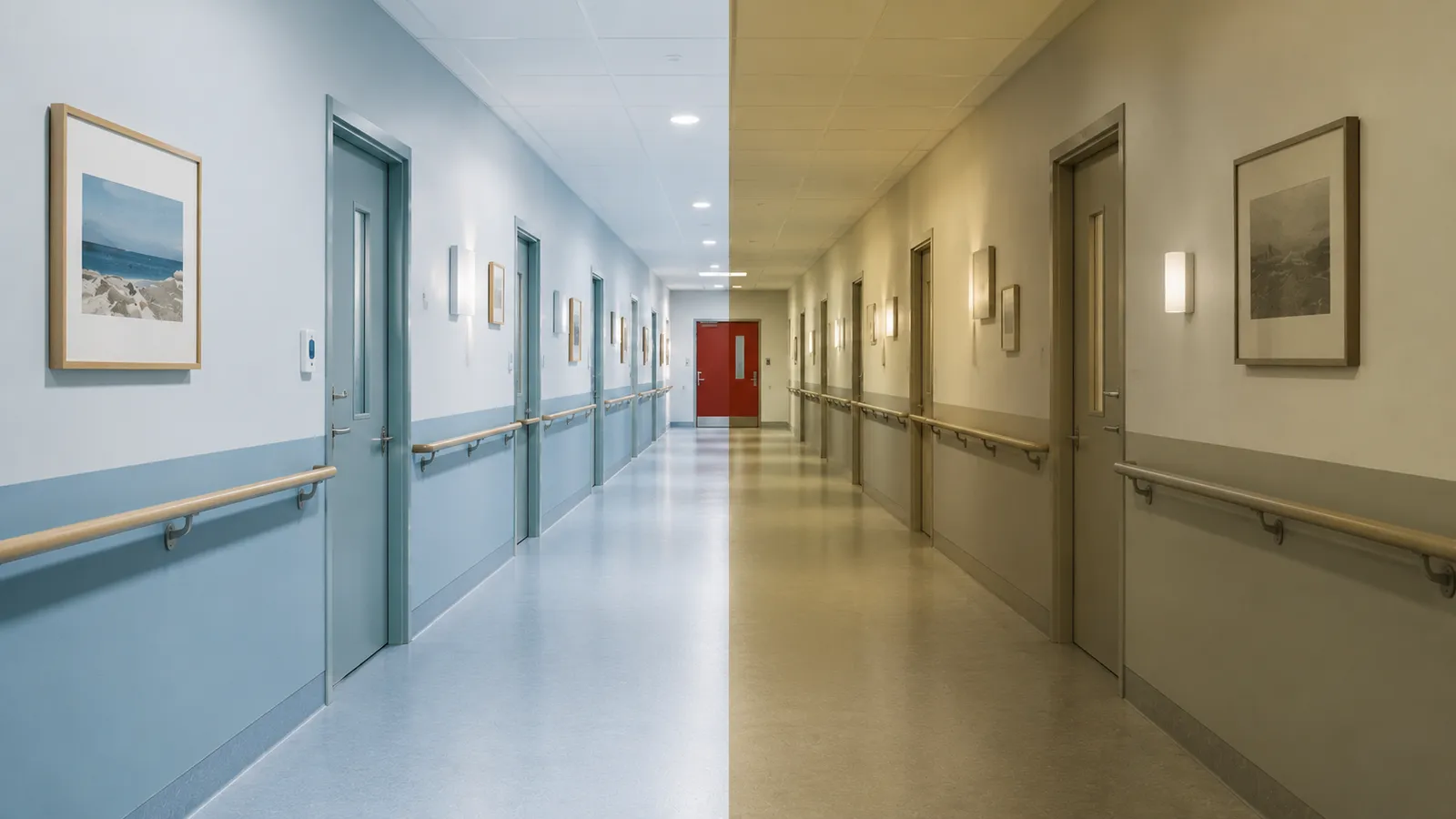
The Designer Is Thirty, the Resident Is Eighty — Why Color in Elderly Care Follows Different Rules
The aging eye sees a different room: less light, less contrast, shifted colors. Why color in elderly and dementia care demands stricter contrast requirements and warm tones — and why red is so important.
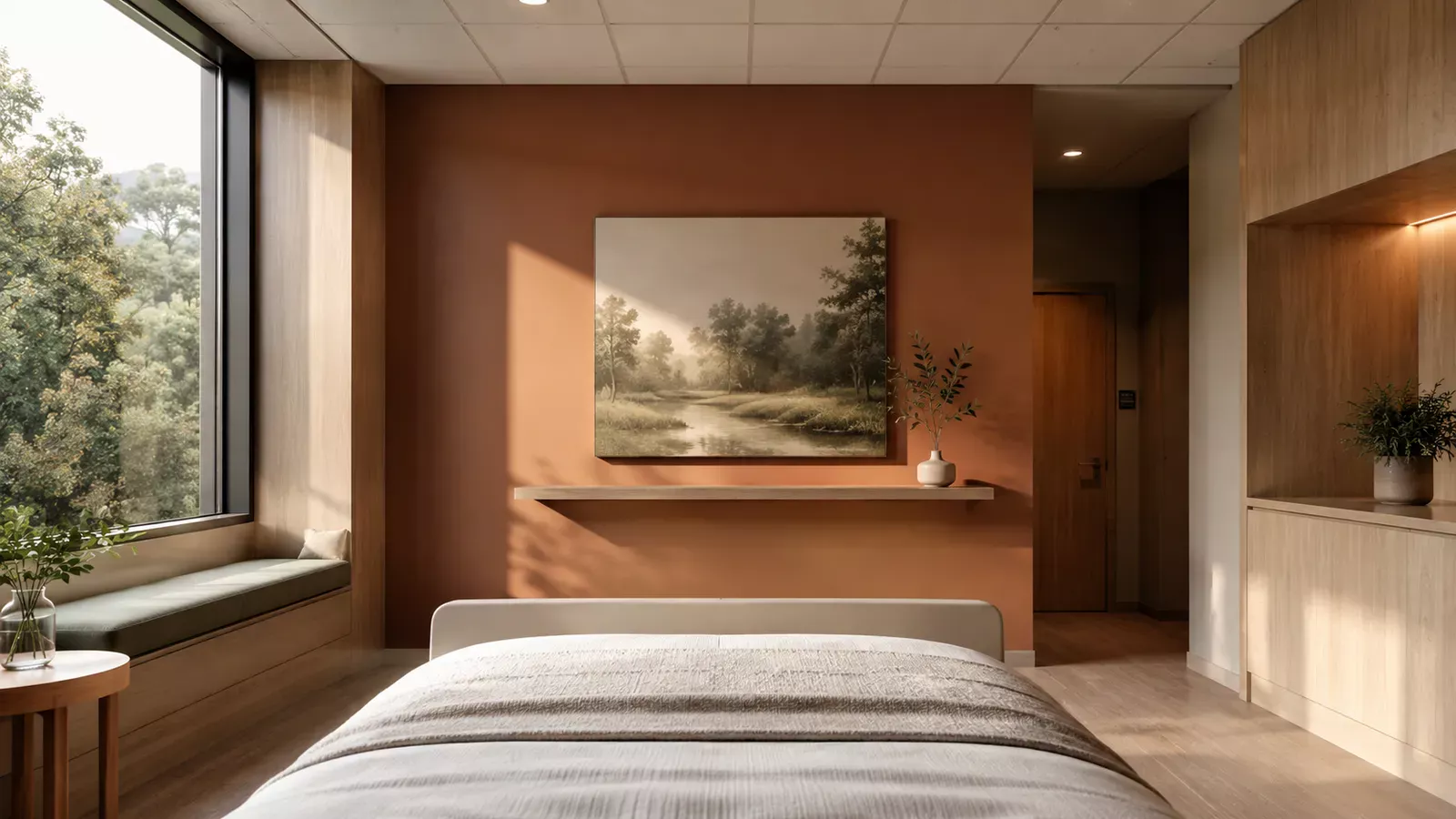
Color in Healthcare Is Not a Matter of Taste — What Science Says About Recovery, Orientation and Safety
Color in healthcare environments is not decoration but a design decision with effects on stress, recovery and safety. What works per room — from waiting room to dementia care.
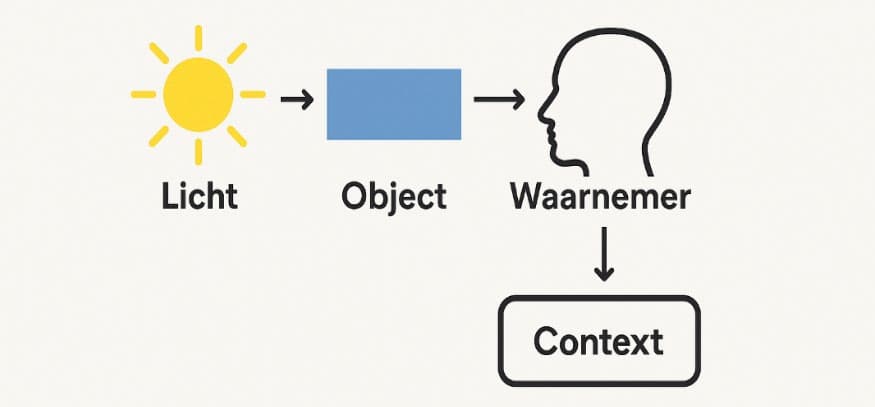
Understanding Color Perception: Four Factors That Determine Every Assessment
Color is not a property of an object, but a perception. Four factors — light source, object, observer and context — together determine what we see. Understand these components and take control of your color assessments.