Laden...

Laden...
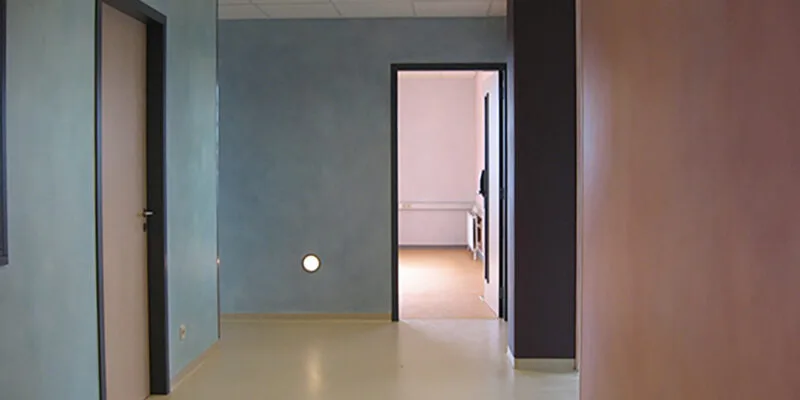
We often experience outdoors that the green landscape provides rest and relaxation. But the same green color works very differently in an interior space – such as a waiting room or hallway. This shows how strongly context determines how we psychologically experience color.
Color influences our mood and thereby also our behavior. A color with low saturation has a lower energy content than a strongly saturated color. You could say that colors "make noise": some whisper, others scream.
Because color carries energy, the color of a space always has a direct influence on how people feel, behave, and move there.
When choosing colors, the function of the space must always be leading.
Color therefore partly determines how long someone wants or can stay somewhere, and how comfortable someone feels.
Too often, color is chosen based on personal taste of the client or the color professional.
An example is the use of high-energy, saturated colors in elementary schools. Precisely there, many children who are sensitive to stimuli are present. For them, bright colors can lead to stress, restlessness, or overstimulation.
Color is therefore not only aesthetic – it is behavior, feeling, and well-being.
Everyone who works professionally with color bears a responsibility for the users of a space.
A hospital, specialized school, or care institution requires colors that support rest, overview, and safety. That goes beyond "what we find beautiful." It requires knowledge of color psychology, insight into stimulus load, and responsible color design.
In our color courses, we pay extensive attention to this psychological effect of color in spaces, and to the professional responsibility that comes with it.
In the courses of the Dutch Color School, you will learn:
👉 Visit for courses on color experience, color design, and applied color psychology: https://kleurenschool.nl
Questions about color psychology or color application in spatial design? Contact the specialists at the Netherlands Color Institute: https://snki.nl/en/contact
Red does not mean one thing, and neither does blue. What the two most discussed colors really evoke — universally and culturally — and why 'which red, which blue' determines the meaning.
The Color Experience System: the missing layer that translates an intended experience into a defensible color region in CIE LCh*. What it is and why it works — presented at AIC 2026 in Florence.
Color is not a property of the object but a perception. Discover the three ingredients — light source, object, observer — and the three knobs hue, lightness and saturation.