Laden...

Laden...
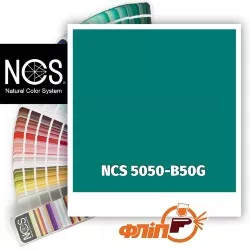
Sometimes NCS notations appear in books or articles that are technically impossible. Examples are 5050-B90G or 2090-Y90R. Although the notations at first glance seem to fit within the NCS structure, these colors cannot exist within the Natural Colour System.
The reason for this lies in the internal mathematical structure of the NCS color space.
In workshops I often say that color, especially within NCS, is largely mathematics.
NCS describes a color as the sum of three components:
According to NCS, the following always applies:
S + C + W = 100%
The whiteness is not mentioned in the notation, because it can simply be derived:
W = 100 – (S + C)
Additionally, a fundamental principle applies within NCS:
Every color always has whiteness greater than 0.
A color with 0% white does not exist within the system.
Take the notation 5050-B90G.
According to the NCS structure, this means:
And that is exactly why this color cannot exist:
Within NCS, W may never be 0.
The sum S + C here is 100, leaving no room for white, and thus the color does not meet the NCS definition of a visual color image.
A color without whiteness would mean:
This results in a theoretical color that is not visually perceptible within the NCS perception model.
The same applies to colors like 2090-Y90R.
Analysis of the notation:
Here even a negative whiteness occurs, which is even more impossible than the previous situation.
Within the NCS system, high saturation always comes at the expense of either the blackness or the whiteness. A saturation of 90% simply leaves insufficient room for both black and white.
For every valid NCS color:
S + C < 100
Because there must always be room for W > 0
The maximum possible saturation depends on the blackness:
Reasons why invalid NCS codes sometimes appear:
When working with NCS colors:
Color: S 3070-B50G
Color: S 3069-B50G
When building color selection tools:
NCS colors like 5050-B90G and 2090-Y90R don't exist because they are mathematically impossible within the NCS color space.
The fundamental rule:
S + C + W = 100, where W > 0
means that:
S + C must always be < 100
This mathematical logic is not a limitation, but an essential part of the NCS system that ensures every color notation corresponds to a visually perceptible color.
For training in NCS color notation, validation and professional color use:
Nederlands Kleur Instituut info@kleurinstituut.nl +31 (75) 6169977
Or visit the Dutch Color School for workshops about color systems and color notation.
In a professional color process, 'red' is at least seven different things. Why that distinction is the foundation beneath reliable color management.
The municipality of Den Helder demands that a bright green house be repainted: the color is allegedly not a pastel color. But what are pastel colors exactly? An analysis using the NCS system.
RAL is more than 216 colors. Discover the three RAL collections, from Classic to Design System plus with 1,825 CIELAB-based colors. Everything about coding, differences, and applications.