Laden...

Laden...
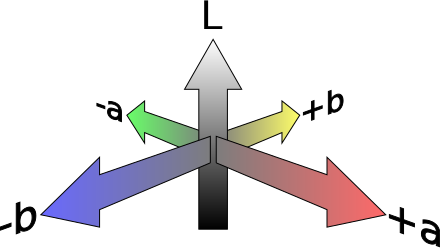
CIELAB and CIELUV were introduced by the CIE in 1976 as approximately uniform color spaces. This means that equal numerical distances approximately correspond to equal visual color differences. These models thus represented an improvement over the non-uniform x,y-space in which MacAdam ellipses vary greatly in size and shape.
Although both models are usable, CIELAB is most commonly applied in technical and industrial color measurement.
CIELAB defines three axes:
The axis cross-section (a*, b*) is always centered around a* = 0, b* = 0, which corresponds to the chosen white reference.
Conditions for the standard formulas: X/Xₙ > 0.008856, Y/Yₙ > 0.008856, Z/Zₙ > 0.008856 (below this threshold, adapted linear formulas apply).
Formulas:
where f(t) = t^(1/3) for t > 0.008856
Here Xₙ, Yₙ, Zₙ are the tristimulus values of the white reference (e.g., D65 or another light source). The white reference thus determines the orientation of the entire CIELAB space.
Many applications prefer saturation and hue over a* and b*. Therefore, polar coordinates are defined:
C*ab = √(a*² + b*²)
hab = arctan(b*/a*)
Characteristics of the hue angle:
Although less commonly applied than CIELAB, CIELUV is particularly useful for:
CIELUV works with L*, u* and v* and is designed to ensure uniform steps in chromaticity under specific conditions.
With CIELAB, it is possible to:
This makes CIELAB the standard model in:
The next article will further elaborate on color differences in CIELAB and the development of ΔE methods.
👉 Want to learn more about CIELAB and color differences? View the courses at kleurenschool.nl
Questions about CIELAB or application in quality control? Contact us via info@kleurinstituut.nl or call +31 (0)70 364 98 02.
A color measurement rarely goes wrong because of the instrument, but because of the conditions around it. The ten most common mistakes in measuring and assessing color — and how to avoid them.
You agree on color with a supplier not with words but with L*a*b* and ΔE. This is how you record color, tolerance and measurement conditions unambiguously — and avoid surprises at delivery.
Eye and meter both assess color, but not in the same way. When to deploy a color meter, when the trained eye leads, and how to calibrate them against each other.