Laden...

Laden...
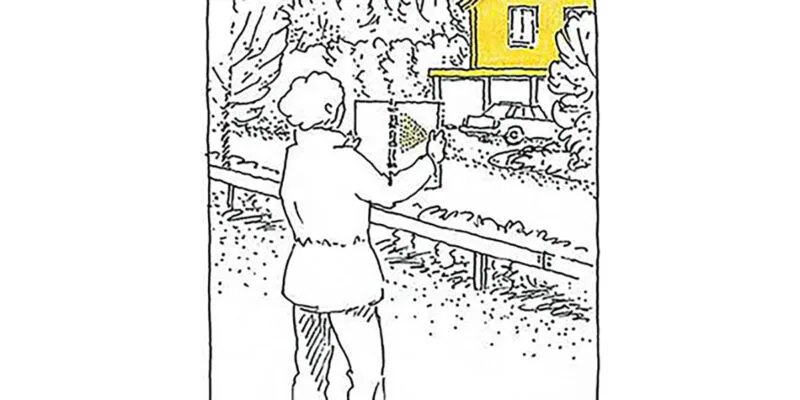
Color seems obvious: we perceive it as if it were always the same. In reality, color continuously changes due to light, distance, gloss, shadow, and environmental influences. A color on a wall is never exactly the same color we perceive from a distance. In this article, we go deeper into this phenomenon and the methods by which color perception can be measured.
A well-known example: the red of a Ferrari looks different at 100 meters than when you stand close or sit in the car looking at the hood. The perceptual color – the color as it appears – depends on distance, angle, and light.
Professionals determine this by comparing color samples at a distance, so that not the inherent color (the physical paint) but the perceived color is central.
Researcher Karin Fridell Anter made an important distinction:
Inherent color The color determined under controlled lighting, directly next to a color sample or with a color meter.
Perceptual color The color as we perceive it at a distance or in context, influenced by light, shadows, gloss, and environment.
In her research, she discovered that painted walls at a distance often appear more saturated and less black than the color samples from which they were chosen. Color systems help to interpret and predict these differences.
With natural objects – such as the flower in a photo – this becomes even more complex: the petals have an almost equal inherent color, but optically show enormous variety in light and dark due to shadow effects.
Color researcher Monica Billger introduced the concept of identity color:
"the most important color impression of a surface or space, which is perceptually experienced as one uniform color."
Before you can describe a color, you must therefore determine: what is the total color impression that the observer experiences as one whole?
For a rose, this can mean that despite variations in light and shadow, you still say: this rose is the same color everywhere. That one perceptive color is then the identity color.
Color can be measured in two ways:
A spectrophotometer measures the objective color values (such as Lab). This provides the physical, reproducible color information.
An observer determines the inherent color by holding a color sample directly against the surface, so that both have the same lighting conditions. This finds a match or close match.
Both methods are forms of measurement – and both are valuable. Unlike with taste, you can argue about color, provided you do so based on correct comparison.
Color perception is not a mysterious phenomenon, but a measurable interaction between light, distance, context, and material. Those who work professionally with color must understand how inherent, perceptual, and identity colors relate in order to make reliable color choices and color assessments.
In the courses of the Dutch Color School, you will learn:
👉 View the courses at: https://kleurenschool.nl
Questions about color perception, identity color, or color measurement? Contact the specialists at the Netherlands Color Institute: https://snki.nl/en/contact
Even the best color assessor has a biological limit. Why two or more assessors judge more reliably — and how the 2+1 method makes that practical and affordable.
A spectrophotometer approves the color, but your eye sees a difference. Why that happens — metamerism, spot measurement, Delta E — and which decision rule to use.
Color is not a property of the object but a perception. Discover the three ingredients — light source, object, observer — and the three knobs hue, lightness and saturation.