Laden...

Laden...
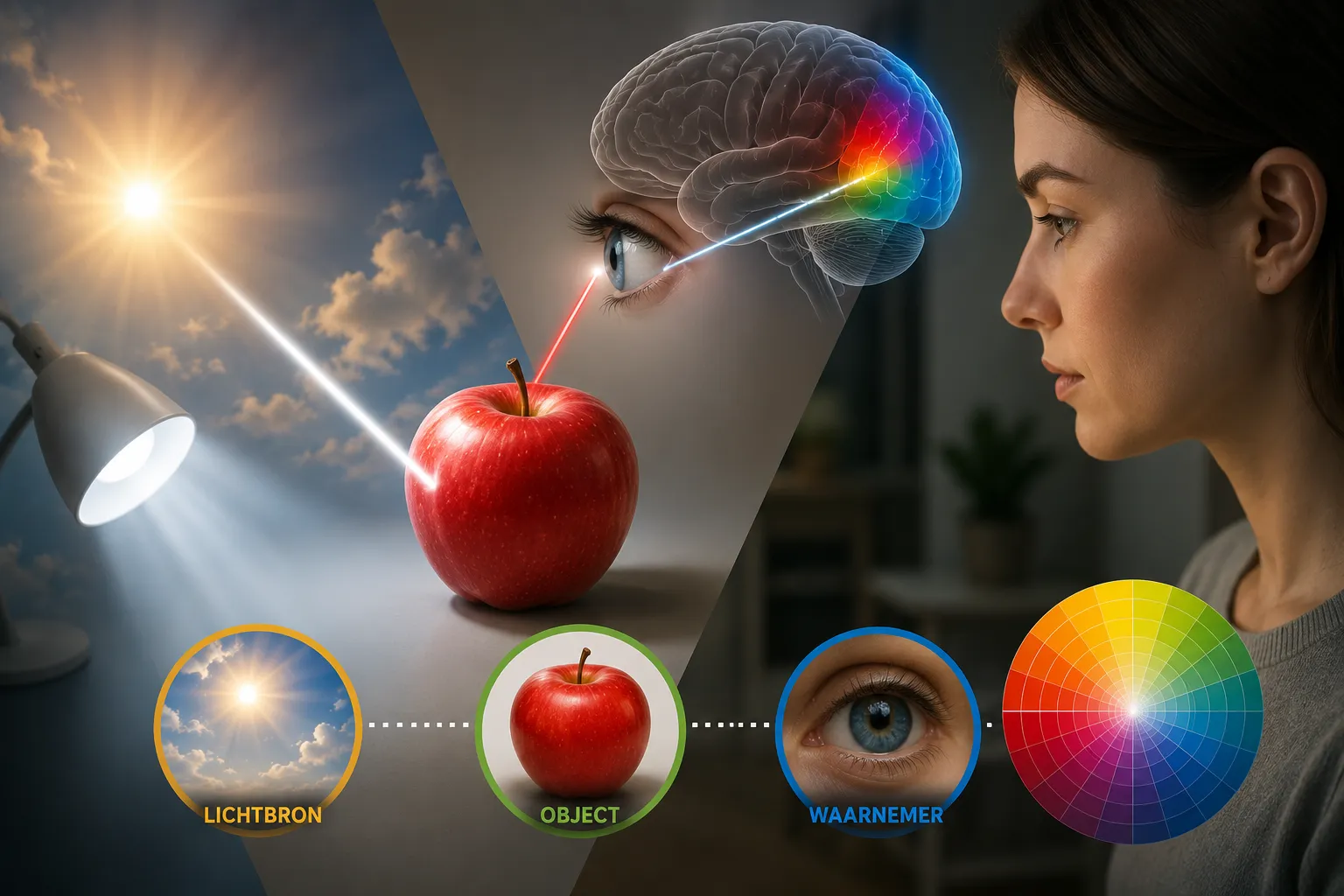
A red apple, a blue sky, a yellow wall. We talk about color as if it were a property of things — something that simply sits "in" them. But it is not. And that is not a play on words: it is the foundation beneath everything you do with color.
Color does not exist without light. In a completely dark room, your red apple has no color — there is nothing to reflect, and thus nothing to see. Light is the physical cause; color is what your visual system makes of it. Color, in other words, is not a thing, but a perception.
What happens physically is this: a light source emits a mixture of wavelengths, the surface of the apple absorbs part of them and bounces the rest back, and that reflected light falls on your eye. The apple therefore "is" not red — the apple mainly reflects the long wavelengths, and your brain turns that into the sensation "red". The color only arises at the end of that chain, in the observer.
Why then does it feel so strongly as if color is a property of the apple? Because an object always reflects roughly the same proportion of the light. Under changing conditions, that yields a comparable color impression every time — and so we attribute that impression to the object. Our brain even actively corrects for the light source, so that a white sheet of paper keeps looking "white" both in the sun and under a lamp. Handy in daily life, but misleading as soon as you work with color professionally.
Every color you see arises from an interplay of three things: a light source, an object and an observer. Change one, and the color changes with it.
Change the light source — from daylight to the fluorescent tube above your desk — and the same fabric can suddenly look different, because different wavelengths are available to reflect. Change the object, for example a different material with a different surface structure, and the way the light is reflected changes. And change the observer, and two people can see exactly the same surface just slightly differently — color perception differs from person to person. Color is not a fixed fact attached to an object; it is the outcome of those three factors together. That is exactly why how your eye turns light into color is just as much part of "what color is" as the paint itself.
That insight has direct consequences. It explains why a sample that matches perfectly in the factory suddenly deviates under different light at the customer: not the material has changed, but the light source. And it explains why "just look for yourself whether it is right" is an unreliable agreement as long as you do not record under which light and by whom the looking is done.
To be able to talk about color without lapsing into vagueness ("a kind of warm bluish gray"), professionals describe every color along three dimensions: the hue (is it red, green, blue?), the lightness (how light or dark?) and the saturation (how full or how drab?). Those three together fix every perceivable color unambiguously.
The usefulness of that is practical. "Make it warmer" is ambiguous; "shift the hue slightly toward yellow" or "increase the saturation" is not. Anyone who masters these basic concepts can name, compare and communicate color instead of guessing at it — and that is exactly the difference between a color agreement that holds and one that leads to discussion.
A nice consequence of all this: there is no "wavelength of purple". All spectral colors are in the rainbow, but purple is not — it only arises when you see the ends of the spectrum, red and blue, together. Purple is thus literally something your brain makes, not a color that exists as such in the light. It is perhaps the clearest proof that color is a perception and not a property of the light.
As soon as you see color as a perception instead of a fixed property, a great deal becomes understandable: why a color looks different in the store than at home, why two people can disagree about "the same" color, and why for reliable color work you must weigh the light source, the object and the observer. That is not a theoretical footnote — it is the basis on which every serious color advice and every reliable color assessment rests.
Do you want to truly master that basis and learn to apply it? Then the Color Science / Color Advice program is the place where you go from "color is a feeling" to "color can be understood and steered".
Source: Hirschler, R. et al. (2018), How much colour science is not too much?, Color Research & Application 43:977–992.
Color is not a property of an object, but a perception. Four factors — light source, object, observer and context — together determine what we see. Understand these components and take control of your color assessments.
The human visual system is not a calibrated measuring device. Cone variation, color blindness and age effects mean that no two assessors perceive identically. Understand the biology behind color assessment.
A fundamental insight that forms the basis for every professional color assessment. Color is not a property of the product, but a perceptual phenomenon that arises from the interplay of four elements.