
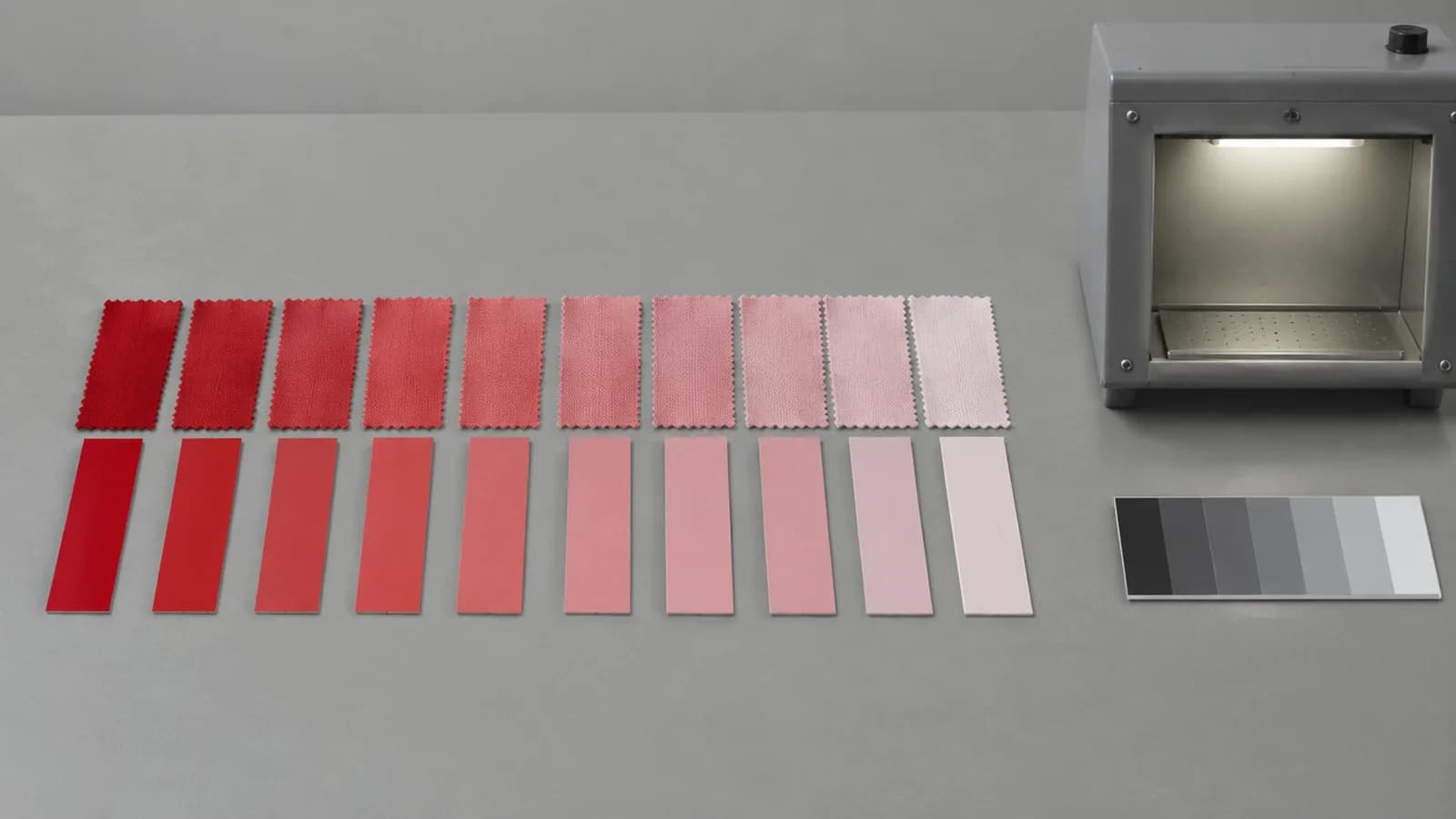
Color that does not last is a quality problem. Why colors fade — through light, washing, friction — and how accelerated tests let you measure in advance whether a color holds up.
A red facade that is pink after two summers, a T-shirt that bleeds in the wash, a packaging that discolors in the shop window: color that does not last is a quality problem. In the profession, that property is called color fastness — the resistance of a color to change over the lifetime of the product. And contrary to what you might think, it can be tested well in advance.
1. What Color Must Defend Itself Against
Color is degraded in different ways, and which one counts depends on the product. Light exposure — especially UV — is decisive for everything that hangs outside: facades, signage, outdoor textiles. Atmospheric factors such as heat, moisture, air pollution and ozone accelerate the breakdown, often in combination. Mechanical stress through friction, folding and abrasion plays a role in textiles and flexible materials. And then there are washing, and chemical action from sweat, cosmetics or foodstuffs.
2. Testing Without Waiting Two Years
You do not want to wait two summers to see whether a color holds up. That is why practice works with a three-stage approach. Accelerated tests imitate years of exposure in a short time under controlled, intensified conditions — think of a xenon lamp simulating sunlight, or a wash-fastness test. Natural aging tests, in which a sample is simply exposed to real use, give the most realistic picture. And correlation analysis calibrates the accelerated outcome against the natural one, because an accelerated test never imitates reality perfectly.
3. From Observation to Number
The outcome is recorded on a scale of 1 to 5 — or 1 to 8 for light stability — where a higher value means better performance. That judgment is made via visual comparison with standardized gray scales, or instrumentally as ΔE between the sample before and after exposure. Besides the fading of the color itself, color transfer is also tested: does the material bleed onto an adjacent white fabric? Thus an intuitive worry — "will this hold up?" — gets a number you can steer by.
4. What This Gives You
Color fastness is not a luxury but risk management. By testing in advance the right exposures that match the end use — light for outdoors, washing for clothing, friction for upholstery — you prevent complaints, returns and image damage afterwards. The art is not to test everything, but to choose per product which exposure really matters and to attach a clear requirement to it.
If you want to learn how to set up and perform such assessments, the Color Assessment program covers it.
Source: Kotterink, M. (2025). Kleurbeoordelen in de Praktijk — Deel 2: Kleurmeting en beoordeling. Uitgeverij SNKI. With the color fastness standards from the ISO 105 series. See in particular chapter 8, and for textiles part 3, chapter 17.
Frequently asked questions
What is color fastness and how do you test it?
Color fastness is the resistance of a color to change over the lifetime of a product. Color is degraded by light/UV, atmospheric factors (heat, moisture, ozone), mechanical stress (friction, folding), washing and chemical action (sweat, cosmetics). Testing happens in three steps: accelerated tests (controlled and intensified, e.g. xenon lamp for sunlight), natural aging tests (realistic), and correlation analysis that calibrates the two. The outcome is recorded on a scale of 1-5 (1-8 for light stability; higher is better), visually via gray scales or instrumentally as ΔE before and after exposure. Color transfer onto adjacent white material is also tested. Choose per product the exposure that matches the end use.
Related articles

A Hospital Knows No Night — Why Light and Color Together Determine Recovery
A hospital knows no night — and that harms recovery. Why the day-night rhythm, dynamic lighting and wall color together form one system in the healthcare environment.
Understanding Color Perception: Four Factors That Determine Every Assessment
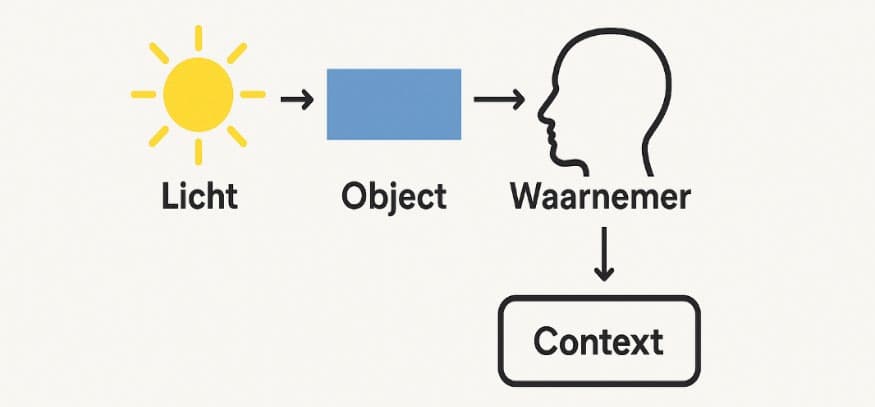
Color is not a property of an object, but a perception. Four factors — light source, object, observer and context — together determine what we see. Understand these components and take control of your color assessments.
Light Sources and Color Assessment: Why the Right Lighting Determines Everything
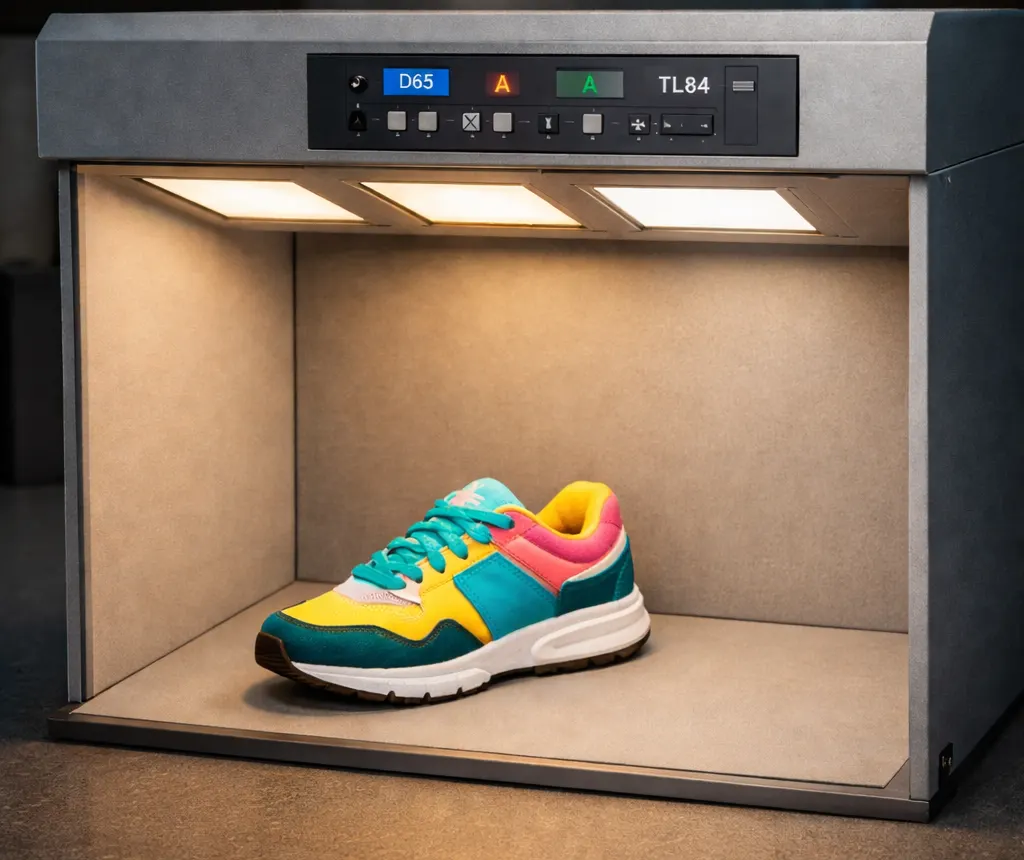
Light is not neutral. Every light source has its own spectral composition that directly determines which colors you can perceive. Understanding SPD, color temperature and CRI is the basis of reliable color assessment.