

Even the best color assessor has a biological limit. Why two or more assessors judge more reliably — and how the 2+1 method makes that practical and affordable.
One experienced color assessor seems enough. Yet the research shows otherwise: even the best assessor has limits that cannot be overcome with experience or concentration — but can be with a second pair of eyes.
1. The Hard Limit of One Assessor
The classic studies by Keith McLaren produced a sobering finding: at very small color differences (ΔE below 0.5), even a top expert hardly performs better than guessing, with some 50 to 60% correct decisions. Only with clearly visible differences does accuracy rise, but even at a ΔE around 3.0 it rarely climbs above 95%. That is not a matter of poor looking — it is the biological upper limit of the human eye.
Moreover, the errors are not evenly distributed. They occur about 30% more often in the blue-green region than in red-yellow, texture increases the error rate by 15 to 40%, and metameric pairs give up to three times as many errors as ordinary samples with the same ΔE.
2. Why Multiple Eyes Make the Difference
McLaren's crucial insight was the distinction between two kinds of errors. Random errors are the arbitrary noise of the visual system; systematic errors are the fixed preferences and blind spots of an individual assessor. Random errors average out as soon as you combine multiple independent judgments, and the systematic strengths and weaknesses of different people complement each other.
Reliability therefore increases quickly with the number of assessors — up to about five to seven. After that, the gain levels off. McLaren showed that a double assessment alone, preferably by different people or at different moments, lowers the chance of a wrong decision by about 40%.
3. Diversity Counts
There is one catch: consensus protects excellently against random errors, but can actually reinforce systematic errors if all assessors share the same training and background. Research from the textile industry suggests that mixed panels are up to 20% more robust against such shared blind spots than homogeneous expert groups. Difference in background is here not a concession but a quality advantage.
4. What This Gives You
You do not need to summon a panel for every assessment. A practical middle ground is the 2+1 method from the automotive industry: two assessors look independently, and only in case of disagreement is a third brought in. Reserve that heavier procedure for critical or borderline cases, and use one assessor for routine work. This way you buy reliability exactly where it matters.
If you want to train assessors to a level where their judgment counts, the Color Assessment program exists for that.
Source: Kotterink, M. (2025). Kleurbeoordelen in de Praktijk — Deel 2: Kleurmeting en beoordeling. Uitgeverij SNKI. With the work of McLaren (1976) on the precision of industrial color assessment. See in particular chapter 11.
Frequently asked questions
Why are multiple assessors more reliable than one in color assessment?
Even a top expert performs only 50-60% better than guessing at very small color differences (ΔE<0.5); that is the biological limit of the eye. Multiple independent judgments average out the random errors and let the systematic blind spots of individuals complement each other. Reliability rises quickly up to about 5-7 assessors; a double assessment alone already lowers the chance of a wrong decision by ~40% (McLaren). Mixed panels are up to 20% more robust against shared systematic errors. Practically, the 2+1 method works: two assessors independently, a third only in case of disagreement.
Related articles

Why Your Eye Sees Less Sharply After an Hour
The eye is an instrument that tires, without an error message. Why your color judgment dulls after an hour — and with which simple rules you take critical decisions at the right moment.
The Ten Most Common Mistakes in Measuring and Assessing Color
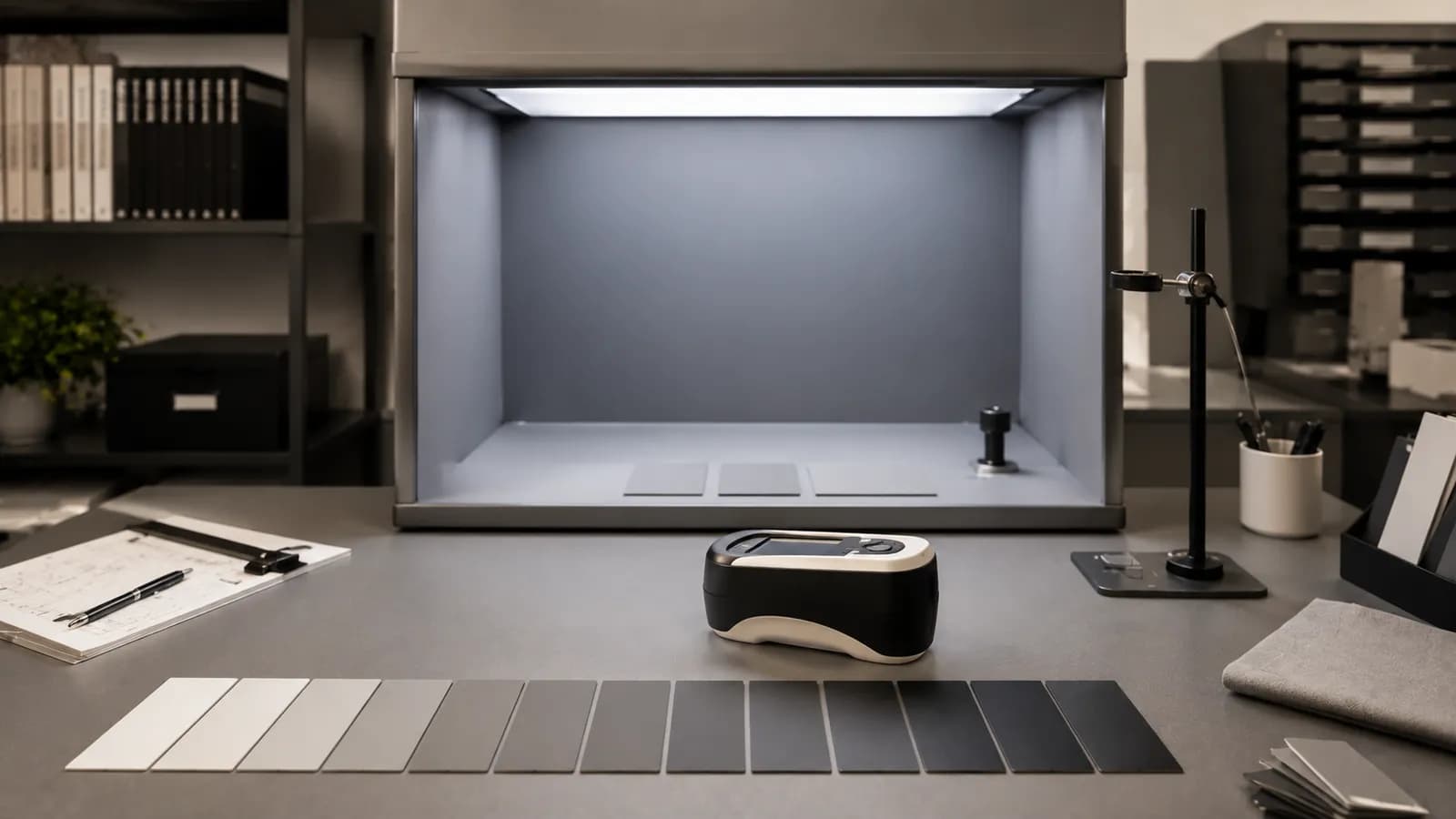
A color measurement rarely goes wrong because of the instrument, but because of the conditions around it. The ten most common mistakes in measuring and assessing color — and how to avoid them.
Your Measuring Equipment Is Qualified — and the Human Who Assesses the Color?
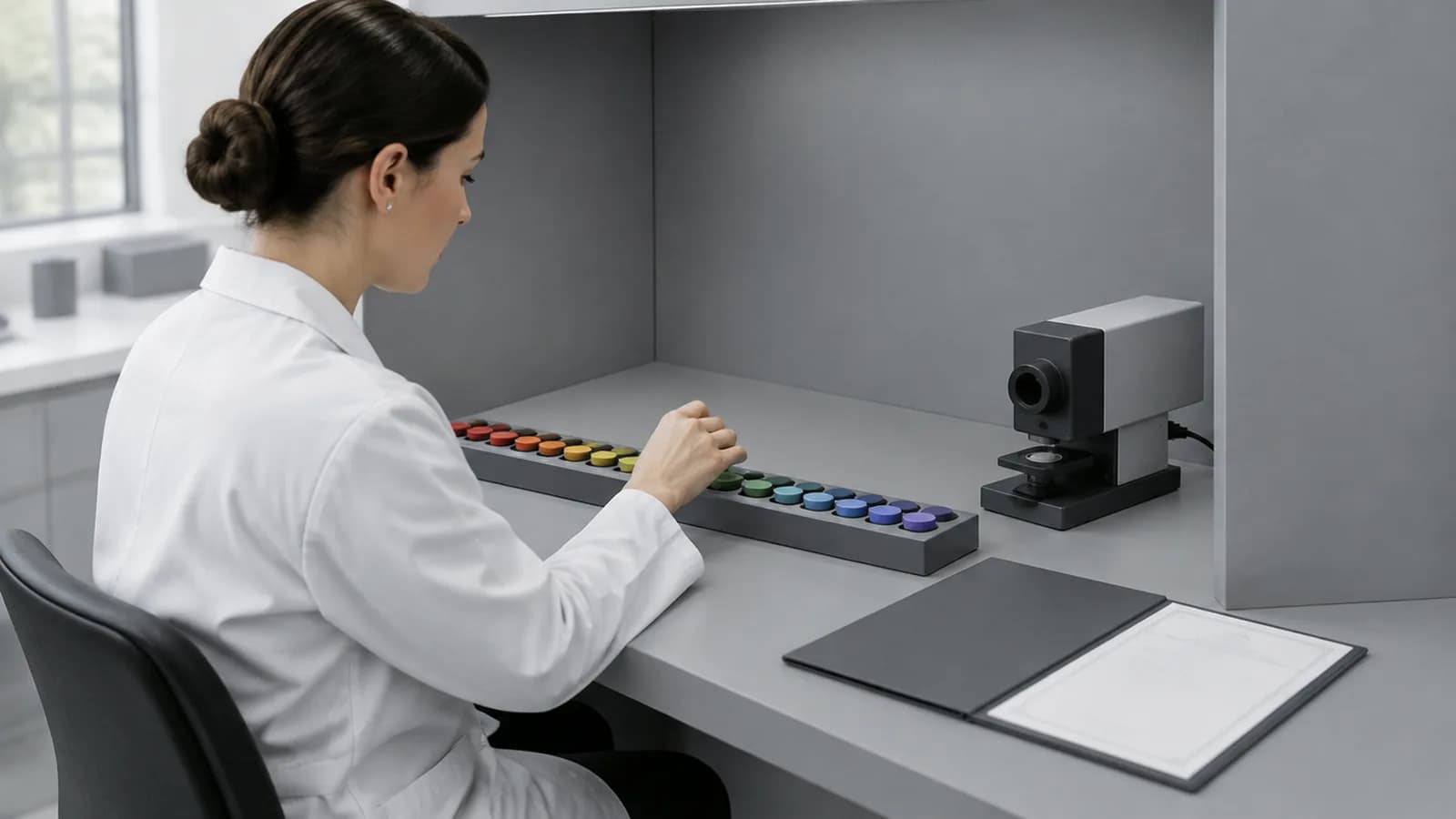
Your measuring equipment is qualified — but the human who assesses the color? ASTM E1499 requires demonstrable observer competence. How ColorAptitude measures, certifies and makes it auditable.