
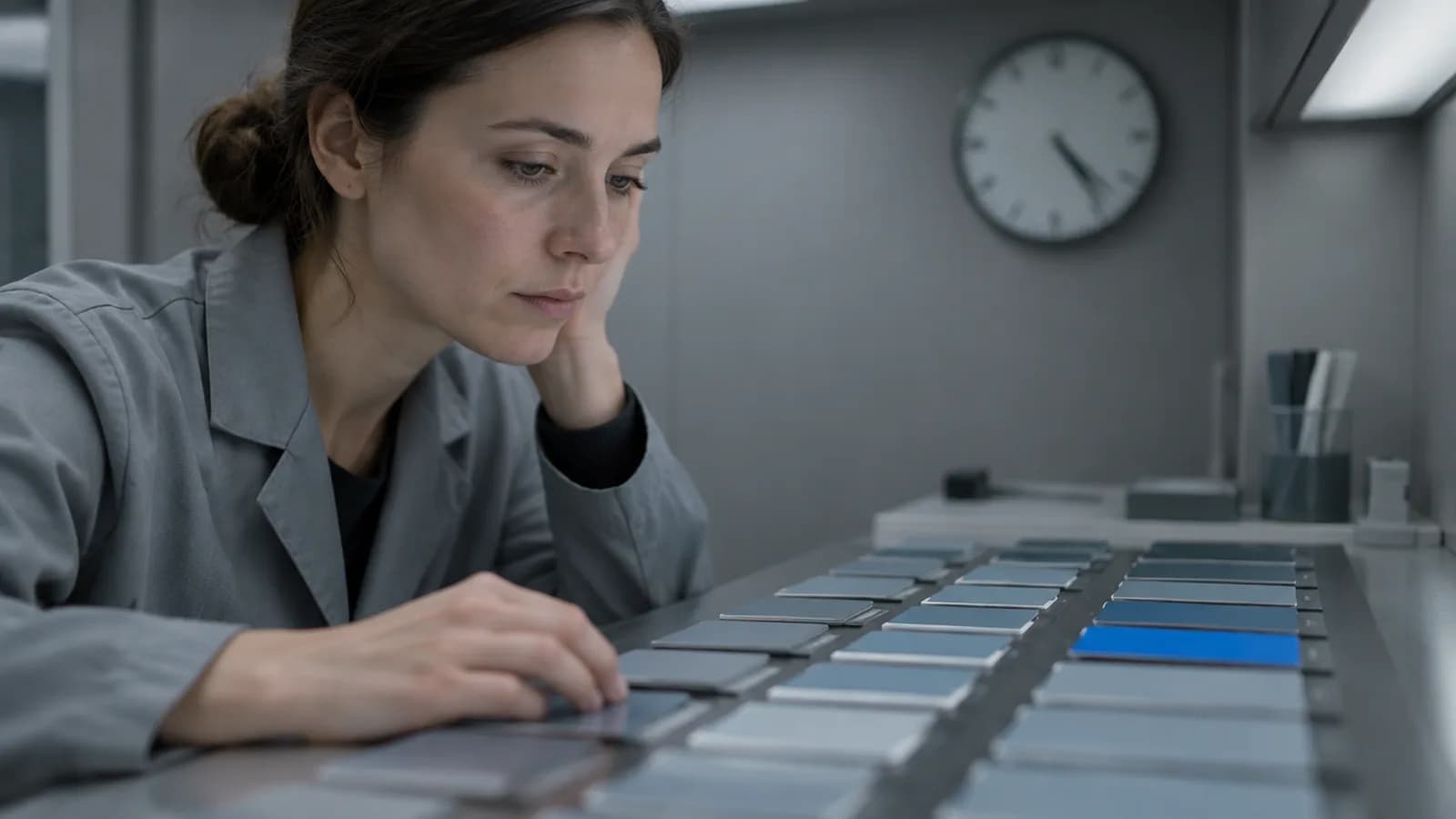
The eye is an instrument that tires, without an error message. Why your color judgment dulls after an hour — and with which simple rules you take critical decisions at the right moment.
Assessing color does not feel like heavy work — you just look. But the eye is an instrument that tires, and unlike a meter it gives no error message when it goes out of shape. Anyone who does not know this takes the most important decisions at the wrong moment.
1. The Clock Ticks Faster Than You Think
McLaren demonstrated as early as 1976 that after 45 to 60 minutes of uninterrupted color assessment, the threshold for seeing subtle differences rises by 35 to 50%. Concretely: a difference you still saw at ΔE 0.5 at the start of the session, you only notice at ΔE 1 after an hour. You have not become less skilled — your eye has temporarily dulled. After one to two hours of intensive work, the decline in accuracy is simply measurable.
2. Two Phenomena Behind the Fatigue
The first is chromatic fatigue: if you work long with the same color family, your sensitivity to small variations within exactly that family declines. Details you saw effortlessly in the morning, you miss in the afternoon. The second is adaptation when switching tasks — if you jump from large to small color differences, your eye needs about 15 to 20 minutes to adjust to the new precision.
On top of that comes the rhythm of the day: color perception generally peaks late in the morning, around ten to eleven o'clock, with a dip in the early afternoon.
3. What This Gives You
A few simple rules catch most of it. Plan critical assessments in the morning, not at the end of a long session. Keep continuous assessment limited to about 45 minutes and then take a break — the rule of thumb is about 15 minutes of rest per hour. After vivid or unusual colors, give your eye a moment to neutralize against a neutral gray background. And do not expect to be sharp immediately when switching from coarse to fine work.
None of these measures costs money — they only cost the discipline not to keep working at the moment it seems possible. How to train these and other assessment skills systematically is covered in the Color Assessment program.
Source: Kotterink, M. (2025). Kleurbeoordelen in de Praktijk — Deel 2: Kleurmeting en beoordeling. Uitgeverij SNKI. With the work of McLaren (1976) on the limits of visual assessment. See in particular chapter 11.
Frequently asked questions
Why does the eye become less reliable during prolonged color assessment?
After 45-60 minutes of uninterrupted assessing, the threshold for seeing subtle color differences rises by 35-50%: a difference that was first visible at ΔE 0.5 is only noticed at ΔE 1 (McLaren 1976). Two causes: chromatic fatigue (working long with one color family lowers your sensitivity to it) and adaptation when switching tasks (15-20 min needed to adjust to new precision). Color perception moreover peaks late in the morning (10-11 o'clock). Solution: critical assessments in the morning, sessions of max ~45 minutes, ~15 min break per hour, and neutralizing after vivid colors.
Related articles
Why Two Assessors See Better Than One
Even the best color assessor has a biological limit. Why two or more assessors judge more reliably — and how the 2+1 method makes that practical and affordable.
The Ten Most Common Mistakes in Measuring and Assessing Color
A color measurement rarely goes wrong because of the instrument, but because of the conditions around it. The ten most common mistakes in measuring and assessing color — and how to avoid them.
Your Measuring Equipment Is Qualified — and the Human Who Assesses the Color?
Your measuring equipment is qualified — but the human who assesses the color? ASTM E1499 requires demonstrable observer competence. How ColorAptitude measures, certifies and makes it auditable.